

moabb.datasets.ErpCore2021_N170#
- class moabb.datasets.ErpCore2021_N170(subjects=None, sessions=None, *, return_all_modalities=False, **kwargs)[source]#
Bases:
ErpCore2021[source]Dataset Snapshot
ErpCore2021_N170
P300 / ERP, 2 classes (Target vs NonTarget)
P300 / ERP Code: ErpCore2021-N170 40 subjects 1 session 30 ch 1024 Hz 2 classes 1.0 s trials CC BY 4.0Class Labels: Target, NonTarget
Citation & Impact
- Paper DOI10.1016/j.neuroimage.2020.117465
- CitationsLoading…
- Public APICrossref | OpenAlex
- Page Views30d: 4 · all-time: 46#69 of 152 · Top 46% most viewedUpdated: 2026-03-30 UTC
Stimulus Protocol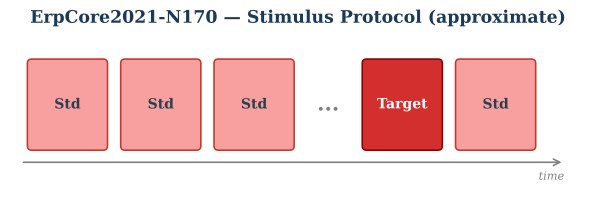
1s task window per trial · 2-class p300 / erp paradigm · 1 runs/session across 1 sessions
HED Event TagsHED tagsSource: MOABB BIDS HED annotation mapping.
TargetSensory-eventExperimental-stimulusVisual-presentationTargetNonTargetSensory-eventExperimental-stimulusVisual-presentationNon-targetHED tree view
Tree · Target
├─ Sensory-event ├─ Experimental-stimulus ├─ Visual-presentation └─ Target
Tree · NonTarget
├─ Sensory-event ├─ Experimental-stimulus ├─ Visual-presentation └─ Non-target
Channel SummaryTotal channels30EEG30EOG3Montage10-05Sampling1024 HzNotch / line50 HzThis diagram is automatically generated from MOABB metadata. Please consult the original publication to confirm the experimental protocol details.
N170 events of the ERP CORE dataset by Kappenman et al. 2020.
Datasets [1] from the article [2].
Dataset Description
The ERP CORE dataset includes data from 40 neurotypical young adults (25 female, 15 male; Mean years of age = 21.5, SD = 2.87, Range 18–30; 38 right handed) from the University of California. Each participant had native English competence and normal color perception, normal or corrected-to-normal vision, and no history of neurological injury or disease (as indicated by self-report). They participated in six 10-minutes optimized experiments designed to measure seven widely used ERP components: N170, Mismatch Negativity (MMN), N2pc, N400, P3, Lateralized Readiness Potential (LRP), and Error-Related Negativity (ERN). These experiments were conducted to standardize ERP paradigms and protocols across studies.
Experimental procedure: Subjects viewed faces and objects to elicit the N170 component. In this task, an image of a face, car, scrambled face, or scrambled car was presented on each trial in the center of the screen, and participants responded whether the stimulus was an “object” (face or car) or a “texture” (scrambled face or scrambled car).
The continuous EEG was recorded using a Biosemi ActiveTwo recording system with active electrodes (Biosemi B.V., Amsterdam, the Netherlands). Recording from 30 scalp electrodes, mounted in an elastic cap and placed according to the International 10/20 System (FP1, F3, F7, FC3, C3, C5, P3, P7, P9, PO7, PO3, O1, Oz, Pz, CPz, FP2, Fz, F4, F8, FC4, FCz, Cz, C4, C6, P4, P8, P10, PO8, PO4, O2; see Supplementary Fig. S1). The common mode sense (CMS) electrode was located at PO1, and the driven right leg (DRL) electrode was located at PO2. The horizontal electrooculogram (HEOG) was recorded from electrodes placed lateral to the external canthus of each eye. The vertical electrooculogram (VEOG) was recorded from an electrode placed below the right eye. Signals were incidentally also recorded from 37 other sites, but these sites were not monitored during the recording and are not included in the ERP CORE data set. All signals were low-pass filtered using a fifth order sinc filter with a half-power cutoff at 204.8 Hz and then digitized at 1024 Hz with 24 bits of resolution. The signals were recorded in single-ended mode (i.e., measuring the voltage between the active and ground electrodes without the use of a reference), and referencing was performed offline.
References
[1]Emily S. Kappenman, Jaclyn L. Farrens, Wendy Zhang, Andrew X. Stewart, Steven J. Luck. (2020). ERP CORE: An open resource for human event-related potential research. NeuroImage. DOI: https://doi.org/10.18115/D5JW4R
[2]Emily S. Kappenman, Jaclyn L. Farrens, Wendy Zhang, Andrew X. Stewart, Steven J. Luck. ERP CORE: An open resource for human event-related potential research. DOI: https://doi.org/10.1016/j.neuroimage.2020.117465
from moabb.datasets import ErpCore2021_N170

dataset = ErpCore2021_N170()
data = dataset.get_data(subjects=[1])
print(data[1])
Dataset summary
#Subj
40
#Chan
30
#Trials / class
240 NT / 80 T
Trials length
1 s
Freq
1024 Hz
#Sessions
1
- __init__(subjects=None, sessions=None, *, return_all_modalities=False, **kwargs)[source]#
Initialize function for the BaseDataset.
- property all_subjects#
Full list of subjects available in this dataset (unfiltered).
- convert_to_bids(path=None, subjects=None, overwrite=False, format='EDF', verbose=None, generate_figures=False)[source]#
Convert the dataset to BIDS format.
Saves the raw EEG data in a BIDS-compliant directory structure. Unlike the caching mechanism (see
CacheConfig), the files produced here do not contain a processing-pipeline hash (desc-<hash>) in their names, making the output a clean, shareable BIDS dataset.- Parameters:
path (str |
Path| None) – Directory under which the BIDS dataset will be written. IfNonethe default MNE data directory is used (same default as the rest of MOABB).subjects (list of int | None) – Subject numbers to convert. If
None, all subjects insubject_listare converted.overwrite (bool) – If
True, existing BIDS files for a subject are removed before saving. Default isFalse.format (str) – The file format for the raw EEG data. Supported values are
"EDF"(default),"BrainVision", and"EEGLAB".verbose (str | None) – Verbosity level forwarded to MNE/MNE-BIDS.
generate_figures (bool) – If
True, generate interactive neural signature HTML figures in{bids_root}/derivatives/neural_signatures/. Requiresplotly(pip install moabb[interactive]). Default isFalse.
- Returns:
bids_root – Path to the root of the written BIDS dataset.
- Return type:
Examples
>>> from moabb.datasets import AlexMI
>>> dataset = AlexMI()
>>> bids_root = dataset.convert_to_bids(path='/tmp/bids', subjects=[1])
Notes
Use
CacheConfigto configure caching forget_data(). Usemoabb.datasets.bids_interface.get_bids_rootto get the BIDS root path.Added in version 1.5.
- data_path(subject, path=None, force_update=False, update_path=None, verbose=None)[source]#
Return the data BIDS paths of a single subject.
- Parameters:
subject (int) – The subject number to fetch data for.
path (None | str) – Location of where to look for the data storing location. If None, the environment variable or config parameter MNE_(dataset) is used. If it doesn’t exist, the “~/mne_data” directory is used. If the dataset is not found under the given path, the data will be automatically downloaded to the specified folder.
force_update (bool) – Force update of the dataset even if a local copy exists.
update_path (bool | None) – If True, set the MNE_DATASETS_(dataset)_PATH in mne-python config to the given path. If None, the user is prompted.
verbose (bool, str, int, or None) – If not None, override default verbose level (see mne.verbose()).
- Returns:
A list containing the BIDSPath object for the subject’s data file.
- Return type:
- download(subject_list=None, path=None, force_update=False, update_path=None, accept=False, verbose=None)[source]#
Download all data from the dataset.
This function is only useful to download all the dataset at once.
- Parameters:
subject_list (list of int | None) – List of subjects id to download, if None all subjects are downloaded.
path (None | str) – Location of where to look for the data storing location. If None, the environment variable or config parameter
MNE_DATASETS_(dataset)_PATHis used. If it doesn’t exist, the “~/mne_data” directory is used. If the dataset is not found under the given path, the data will be automatically downloaded to the specified folder.force_update (bool) – Force update of the dataset even if a local copy exists.
update_path (bool | None) – If True, set the MNE_DATASETS_(dataset)_PATH in mne-python config to the given path. If None, the user is prompted.
accept (bool) – Accept licence term to download the data, if any. Default: False
verbose (bool, str, int, or None) – If not None, override default verbose level (see
mne.verbose()).
- static encode_event(row)[source]#
Encode a single event values based on the task-specific criteria.
- Parameters:
row (
pandas.Series) – A row of the events DataFrame.- Returns:
Encoded event value.
- Return type:
- encoding(events_df)[source]#
Encode the column value in the events DataFrame.
- Parameters:
events_df (
pandas.DataFrame) – DataFrame containing the events information.- Returns:
A tuple containing the encoded event values and the mapping dictionary.
- Return type:
- get_additional_metadata(subject: str, session: str, run: str)[source]#
Load additional metadata for a specific subject, session, and run.
This method is intended to be overridden by subclasses to provide additional metadata specific to the dataset. The metadata is typically loaded from an events.tsv file or similar data source.
- Parameters:
- Returns:
A DataFrame containing the additional metadata if available, otherwise None.
- Return type:
None |
pandas.DataFrame
- get_block_repetition(paradigm, subjects, block_list, repetition_list)[source]#
Select data for all provided subjects, blocks and repetitions.
subject -> session -> run -> block -> repetition
See also
- get_data(subjects=None, cache_config=None, process_pipeline=None)[source]#
Return the data corresponding to a list of subjects.
The returned data is a dictionary with the following structure:
data = {'subject_id' :
            {'session_id':
                {'run_id': run}
            }
        }
subjects are on top, then we have sessions, then runs. A sessions is a recording done in a single day, without removing the EEG cap. A session is constitued of at least one run. A run is a single contiguous recording. Some dataset break session in multiple runs.
Processing steps can optionally be applied to the data using the
*_pipelinearguments. These pipelines are applied in the following order:raw_pipeline->epochs_pipeline->array_pipeline. If a*_pipelineargument isNone, the step will be skipped. Therefore, thearray_pipelinemay either receive amne.io.Rawor amne.Epochsobject as input depending on whetherepochs_pipelineisNoneor not.- Parameters:
subjects (List of int) – List of subject number
cache_config (dict |
CacheConfig) – Configuration for caching of datasets. SeeCacheConfigfor details.process_pipeline (
sklearn.pipeline.Pipeline| None) – Optional processing pipeline to apply to the data. To generate an adequate pipeline, we recommend usingmoabb.make_process_pipelines(). This pipeline will receivemne.io.BaseRawobjects. The steps names of this pipeline should be elements ofStepType. According to their name, the steps should either return amne.io.BaseRaw, amne.Epochs, or anumpy.ndarray. This pipeline must be “fixed” because it will not be trained, i.e. no call tofitwill be made.
- Returns:
data – dict containing the raw data
- Return type:
Dict
- handle_events_reading(events_path, raw)[source]#
Read associated events.tsv and populate raw with annotations.
- Parameters:
events_path (str) – The path to the events file.
raw (mne.io.Raw) – The raw EEG data object.
- Returns:
The updated raw EEG data object with annotations.
- Return type:
- property metadata[source]#
Return structured metadata for this dataset.
Returns the DatasetMetadata object from the centralized catalog, or None if metadata is not available for this dataset.
- Returns:
The metadata object containing acquisition parameters, participant demographics, experiment details, and documentation. Returns None if no metadata is registered for this dataset.
- Return type:
DatasetMetadata| None
Examples
>>> from moabb.datasets import BNCI2014_001
>>> dataset = BNCI2014_001()
>>> dataset.metadata.participants.n_subjects
9
>>> dataset.metadata.acquisition.sampling_rate
250.0