

moabb.datasets.BNCI2015_007#
- class moabb.datasets.BNCI2015_007(subjects=None, sessions=None)[source]#
Bases:
MNEBNCI[source]Dataset Snapshot
BNCI2015_007
Exploring motion VEPs for gaze-independent communication
P300 / ERP, 2 classes (Target vs NonTarget)
P300 / ERP Code: BNCI2015-007 16 subjects 1 session 63 ch 100 Hz 2 classes 30.0 s trials CC BY-NC-ND 4.0Class Labels: Target, NonTarget
Citation & Impact
- Paper DOI10.1088/1741-2560/11/2/026009
- CitationsLoading…
- Public APICrossref | OpenAlex
- Data DOI10.1088/1741-2560/9/4/045006
- Page Views30d: 8 · all-time: 10#89 of 151 · Top 59% most viewedUpdated: 2026-03-20 UTC
Stimulus Protocol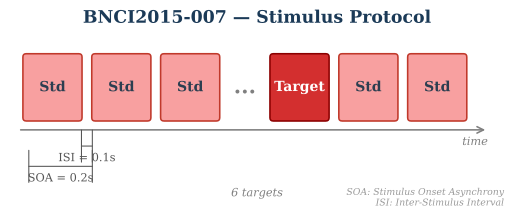
30s task window per trial · 2-class p300 / erp paradigm · 2 runs/session across 1 sessions
HED Event TagsHED tagsSource: MOABB BIDS HED annotation mapping.
TargetSensory-eventExperimental-stimulusVisual-presentationTargetNonTargetSensory-eventExperimental-stimulusVisual-presentationNon-targetHED tree view
Tree · Target
├─ Sensory-event ├─ Experimental-stimulus ├─ Visual-presentation └─ Target
Tree · NonTarget
├─ Sensory-event ├─ Experimental-stimulus ├─ Visual-presentation └─ Non-target
Channel SummaryTotal channels63EEG63 (active electrode)Montage10-10Sampling100 HzReferencelinked mastoidsFilterhardware bandpass filter 0.016–250 HzNotch / line50 HzThis diagram is automatically generated from MOABB metadata. Please consult the original publication to confirm the experimental protocol details.
BNCI 2015-007 Motion VEP (mVEP) Speller dataset.
Dataset from [1].
Dataset Description
This dataset implements a motion-onset visual evoked potential (mVEP) based brain-computer interface for gaze-independent spelling. Unlike conventional flash-based P300 spellers that use luminance changes, this paradigm uses motion onset (moving bar stimuli) to elicit visual evoked potentials, specifically the N200 component. This approach has advantages including lower visual fatigue, reduced luminance and contrast requirements, and potential for use in bright environments.
The motion VEP (mVEP) speller operates by presenting moving bar stimuli at different positions in a matrix layout. When the user attends to a target position, the motion onset at that location elicits a characteristic N200 response that can be detected to determine the user’s intended selection.
Participants
16 healthy subjects
Gender: Not specified in metadata
Age: Not specified in metadata
BCI experience: Not specified
Health status: Healthy volunteers
Location: Neurotechnology Group, Technische Universitat Berlin, Germany
Recording Details
Equipment: BrainProducts actiCap active electrode system
Channels: 63 EEG electrodes (standard 10-10 system)
Sampling rate: 100 Hz (downsampled from original recording)
Reference: Nose reference
Montage: standard_1005
Filters: Bandpass filtered during preprocessing
Units: uV (converted to V during loading)
Experimental Procedure
6x6 matrix speller layout (36 possible targets)
Motion onset stimulation (moving bars)
6 stimulus positions per row/column
Overt attention paradigm (gaze-dependent) and covert attention modes
One recording session per subject with multiple runs (typically 2)
Each run contains multiple spelling sequences
Data Organization
Subject codes: fat, gdf, gdg, iac, iba, ibe, ibq, ibs, ibt, ibu, ibv, ibw, ibx, iby, ice, icv
Data URL: http://doc.ml.tu-berlin.de/bbci/BNCIHorizon2020-MVEP/
Event Codes
Target (1): Target stimulus presented (attended)
NonTarget (2): Non-target stimulus presented (not attended)
References
[1]Treder, M. S., Purwins, H., Miklody, D., Sturm, I., & Blankertz, B. (2012). Decoding auditory attention to instruments in polyphonic music using single-trial EEG classification. Journal of Neural Engineering, 11(2), 026009. https://doi.org/10.1088/1741-2560/11/2/026009
from moabb.datasets import BNCI2015_007

dataset = BNCI2015_007()
data = dataset.get_data(subjects=[1])
print(data[1])
Dataset summary
#Subj
16
#Chan
63
#Trials / class
varies NT / T
Trials length
0.7 s
Freq
100 Hz
#Sessions
1
Participants
Population: Healthy
Age: 23.8 (range: 21-30) years
Handedness: normal or corrected-to-normal vision
BCI experience: naive
Equipment
Amplifier: BrainAmp EEG amplifier
Electrodes: active electrode
Montage: 10-10
Reference: linked mastoids
Preprocessing
Data state: filtered
Bandpass filter: 0.016-250 Hz
Steps: downsampling, low-pass filter, baseline correction, artifact rejection
Re-reference: linked mastoids
Notes: For offline analysis: downsampled to 200 Hz, low-pass filtered (42 Hz passband, 49 Hz stopband). For online: downsampled to 100 Hz. Artifact rejection: min-max ≥70 μV. Nontarget epochs filtered to avoid overlap with targets (3 preceding and 4 following stimuli must be nontargets).
Data Access
DOI: 10.1088/1741-2560/9/4/045006
Repository: BNCI Horizon
Experimental Protocol
Paradigm: p300
Task type: visual_speller
Feedback: visual
Stimulus: motion VEP (mVEP)
Dataset summary
Name
#Subj
#Chan
#Trials/class
Trials length
Sampling Rate
#Sessions
BNCI2015_007
16
63
~1800 NT / ~360 T
0.7s
100Hz
1
Notes
Added in version 1.2.0.
See also
BNCI2015_008Center Speller P300 dataset (gaze-independent)
BNCI2015_009AMUSE auditory spatial P300 dataset
BNCI2015_010RSVP visual speller (gaze-independent visual paradigm)
- property all_subjects#
Full list of subjects available in this dataset (unfiltered).
- convert_to_bids(path=None, subjects=None, overwrite=False, format='EDF', verbose=None, generate_figures=False)[source]#
Convert the dataset to BIDS format.
Saves the raw EEG data in a BIDS-compliant directory structure. Unlike the caching mechanism (see
CacheConfig), the files produced here do not contain a processing-pipeline hash (desc-<hash>) in their names, making the output a clean, shareable BIDS dataset.- Parameters:
path (str | Path | None) – Directory under which the BIDS dataset will be written. If
Nonethe default MNE data directory is used (same default as the rest of MOABB).subjects (list of int | None) – Subject numbers to convert. If
None, all subjects insubject_listare converted.overwrite (bool) – If
True, existing BIDS files for a subject are removed before saving. Default isFalse.format (str) – The file format for the raw EEG data. Supported values are
"EDF"(default),"BrainVision", and"EEGLAB".verbose (str | None) – Verbosity level forwarded to MNE/MNE-BIDS.
generate_figures (bool) – If
True, generate interactive neural signature HTML figures in{bids_root}/derivatives/neural_signatures/. Requiresplotly(pip install moabb[interactive]). Default isFalse.
- Returns:
bids_root – Path to the root of the written BIDS dataset.
- Return type:
Examples
>>> from moabb.datasets import AlexMI
>>> dataset = AlexMI()
>>> bids_root = dataset.convert_to_bids(path='/tmp/bids', subjects=[1])
See also
CacheConfigCache configuration for
get_data().moabb.datasets.bids_interface.get_bids_rootReturn the BIDS root path.
Notes
Added in version 1.5.
- data_path(subject, path=None, force_update=False, update_path=None, verbose=None)[source]#
Get path to local copy of a subject data.
- Parameters:
subject (int) – Number of subject to use
path (None | str) – Location of where to look for the data storing location. If None, the environment variable or config parameter
MNE_DATASETS_(dataset)_PATHis used. If it doesn’t exist, the “~/mne_data” directory is used. If the dataset is not found under the given path, the data will be automatically downloaded to the specified folder.force_update (bool) – Force update of the dataset even if a local copy exists.
update_path (bool | None Deprecated) – If True, set the MNE_DATASETS_(dataset)_PATH in mne-python config to the given path. If None, the user is prompted.
verbose (bool, str, int, or None) – If not None, override default verbose level (see
mne.verbose()).
- Returns:
path – Local path to the given data file. This path is contained inside a list of length one, for compatibility.
- Return type:
- download(subject_list=None, path=None, force_update=False, update_path=None, accept=False, verbose=None)[source]#
Download all data from the dataset.
This function is only useful to download all the dataset at once.
- Parameters:
subject_list (list of int | None) – List of subjects id to download, if None all subjects are downloaded.
path (None | str) – Location of where to look for the data storing location. If None, the environment variable or config parameter
MNE_DATASETS_(dataset)_PATHis used. If it doesn’t exist, the “~/mne_data” directory is used. If the dataset is not found under the given path, the data will be automatically downloaded to the specified folder.force_update (bool) – Force update of the dataset even if a local copy exists.
update_path (bool | None) – If True, set the MNE_DATASETS_(dataset)_PATH in mne-python config to the given path. If None, the user is prompted.
accept (bool) – Accept licence term to download the data, if any. Default: False
verbose (bool, str, int, or None) – If not None, override default verbose level (see
mne.verbose()).
- get_additional_metadata(subject: str, session: str, run: str) None | DataFrame[source]#
Load additional metadata for a specific subject, session, and run.
This method is intended to be overridden by subclasses to provide additional metadata specific to the dataset. The metadata is typically loaded from an events.tsv file or similar data source.
- get_block_repetition(paradigm, subjects, block_list, repetition_list)[source]#
Select data for all provided subjects, blocks and repetitions.
subject -> session -> run -> block -> repetition
See also
BaseDataset.get_data
- get_data(subjects=None, cache_config=None, process_pipeline=None)[source]#
Return the data corresponding to a list of subjects.
The returned data is a dictionary with the following structure:
data = {'subject_id' :
            {'session_id':
                {'run_id': run}
            }
        }
subjects are on top, then we have sessions, then runs. A sessions is a recording done in a single day, without removing the EEG cap. A session is constitued of at least one run. A run is a single contiguous recording. Some dataset break session in multiple runs.
Processing steps can optionally be applied to the data using the
*_pipelinearguments. These pipelines are applied in the following order:raw_pipeline->epochs_pipeline->array_pipeline. If a*_pipelineargument isNone, the step will be skipped. Therefore, thearray_pipelinemay either receive amne.io.Rawor amne.Epochsobject as input depending on whetherepochs_pipelineisNoneor not.- Parameters:
subjects (List of int) – List of subject number
cache_config (dict | CacheConfig) – Configuration for caching of datasets. See
CacheConfigfor details.process_pipeline (Pipeline | None) – Optional processing pipeline to apply to the data. To generate an adequate pipeline, we recommend using
moabb.utils.make_process_pipelines(). This pipeline will receivemne.io.BaseRawobjects. The steps names of this pipeline should be elements ofStepType. According to their name, the steps should either return amne.io.BaseRaw, amne.Epochs, or anumpy.ndarray(). This pipeline must be “fixed” because it will not be trained, i.e. no call tofitwill be made.
- Returns:
data – dict containing the raw data
- Return type:
Dict
- property metadata: DatasetMetadata | None[source]#
Return structured metadata for this dataset.
Returns the DatasetMetadata object from the centralized catalog, or None if metadata is not available for this dataset.
- Returns:
The metadata object containing acquisition parameters, participant demographics, experiment details, and documentation. Returns None if no metadata is registered for this dataset.
- Return type:
DatasetMetadata | None
Examples
>>> from moabb.datasets import BNCI2014_001
>>> dataset = BNCI2014_001()
>>> dataset.metadata.participants.n_subjects
9
>>> dataset.metadata.acquisition.sampling_rate
250.0