

moabb.datasets.Thapa2025#
- class moabb.datasets.Thapa2025(subjects=None, sessions=None, *, return_all_modalities=False)[source]#
Bases:
BaseDataset[source]Dataset Snapshot
Thapa2025
A large EEG database of freewill reaching and grasping tasks for brain-machine interfaces: 23 subjects, 49 sessions, 6808 self-paced reach-and-grasp trials toward one of four cups.
Imagery, 4 classes (Tgt1 vs Tgt2 vs Tgt3 vs Tgt4)
Imagery Code: Thapa2025 23 subjects 1 session 39 ch (31 EEG) 250 Hz 4 classes 12.0 s trials CC BY 4.0Class Labels: Tgt1, Tgt2, Tgt3, Tgt4
Citation & Impact
- Paper DOI10.1038/s41597-025-06039-9
- CitationsLoading…
- Public APICrossref | OpenAlex
Stimulus Protocol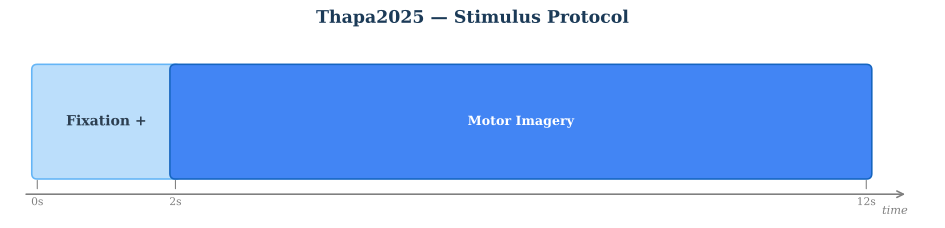
12s task window per trial · 4-class imagery paradigm · 5 runs/session across 1 sessions
HED Event TagsHED tagsSource: MOABB BIDS HED annotation mapping.
Tgt1Sensory-eventLabelTgt2Sensory-eventLabelTgt3Sensory-eventLabelTgt4Sensory-eventLabelHED tree view
Tree · Tgt1
├─ Sensory-event └─ Label
Tree · Tgt2
├─ Sensory-event └─ Label
Tree · Tgt3
├─ Sensory-event └─ Label
Tree · Tgt4
├─ Sensory-event └─ Label
Channel SummaryTotal channels39EEG31 (scalp EEG)EOG4MISC4Montagestandard_1020Sampling250 HzReferenceCzFilternoneNotch / line60 HzThis diagram is automatically generated from MOABB metadata. Please consult the original publication to confirm the experimental protocol details.
Freewill reach-and-grasp motor-execution dataset from Thapa et al. 2025.
Dataset [1] from the study A large electroencephalogram database of freewill reaching and grasping tasks for brain machine interfaces.
EEG from 23 healthy young adults (ages 18-24; 8 female, 15 male, right-handed) performing a self-paced, self-selected reach-and-grasp task. On each trial the subject freely chose one of four cups and, at a moment of their own choosing (~1-2 s after an audio start cue), reached out and grasped it. The four target cups define the four classes:
Tgt1 / Tgt3: water-filled cups
Tgt2 / Tgt4: empty cups
Data were recorded with a Brain Products actiCHamp Plus amplifier and a gel-based actiCAP snap cap, 31-channel extended 10-20 montage (Cz reference, separate ground) plus 4 EOG channels, a single audio-cue trigger channel, and a 3-axis accelerometer at the distal ulna to mark movement onset. The sampling rate is 250 Hz for 21 subjects but 1000 Hz for sub-13 and sub-15, so it is read per subject from the BrainVision header rather than assumed.
The data are distributed in BIDS (BrainVision
.vhdr/.vmrk/.eeg) as a single Figshare archive. Most subjects have 2-3 sessions recorded on different days, except sub-02 and sub-17 who stopped after a single session by preference; each session has 3-7 runs of ~30 trials, for 49 sessions and 6808 trials in total (paper audit, 2026-10-04: receipt session counts are {1: 2 subjects, 2: 16 subjects, 3: 5 subjects}, summing to 49). MOABB session and run keys are the sorted BIDSses-*/run-*entities remapped to integer-prefixed strings.Summary-table trials per class are the cohort mean (6808 / 23 / 4 = 74), not a balanced design: participants freely selected targets.
The
.vmrkfiles hold only a “New Segment” marker; targets are read from the BIDSevents.tsvsidecar, normalising label variants toTgt1..``Tgt4``.References
[1]Thapa, B. R., Boggess, J., & Bae, J. (2025). A large electroencephalogram database of freewill reaching and grasping tasks for brain machine interfaces. Scientific Data, 12(1). https://doi.org/10.1038/s41597-025-06039-9
from moabb.datasets import Thapa2025

dataset = Thapa2025()
data = dataset.get_data(subjects=[1])
print(data[1])
Dataset summary
#Subj
23
#Chan
31
#Classes
4
#Trials / class
74
Trials length
4 s
Freq
250 Hz
#Sessions
2 (1-3)
#Runs
5
Total_trials
6808
Participants
Population: healthy
Handedness: right
Equipment
Amplifier: Brain Products actiCHamp Plus (actiCAP snap, gel-based active electrodes)
Electrodes: scalp EEG
Montage: standard_1020
Reference: Cz
Data Access
DOI: 10.1038/s41597-025-06039-9
Repository: Figshare
Experimental Protocol
Paradigm: imagery
Task type: motor execution
Feedback: none
Stimulus: audio start/end cue
- __init__(subjects=None, sessions=None, *, return_all_modalities=False)[source]#
Initialize function for the BaseDataset.
- property all_subjects#
Full list of subjects available in this dataset (unfiltered).
- convert_to_bids(path=None, subjects=None, overwrite=False, format='EDF', verbose=None, generate_figures=False)[source]#
Convert the dataset to BIDS format.
Saves the raw EEG data in a BIDS-compliant directory structure. Unlike the caching mechanism (see
CacheConfig), the files produced here do not contain a processing-pipeline hash (desc-<hash>) in their names, making the output a clean, shareable BIDS dataset.- Parameters:
path (str |
Path| None) – Directory under which the BIDS dataset will be written. IfNonethe default MNE data directory is used (same default as the rest of MOABB).subjects (list of int | None) – Subject numbers to convert. If
None, all subjects insubject_listare converted.overwrite (bool) – If
True, existing BIDS files for a subject are removed before saving. Default isFalse.format (str) – The file format for the raw EEG data. Supported values are
"EDF"(default),"BrainVision", and"EEGLAB".verbose (str | None) – Verbosity level forwarded to MNE/MNE-BIDS.
generate_figures (bool) – If
True, generate interactive neural signature HTML figures in{bids_root}/derivatives/neural_signatures/. Requiresplotly(pip install moabb[interactive]). Default isFalse.
- Returns:
bids_root – Path to the root of the written BIDS dataset.
- Return type:
Examples
>>> from moabb.datasets import AlexMI
>>> dataset = AlexMI()
>>> bids_root = dataset.convert_to_bids(path="/tmp/bids", subjects=[1])
Notes
Use
CacheConfigto configure caching forget_data(). Usemoabb.datasets.bids_interface.get_bids_rootto get the BIDS root path.Added in version 1.5.
- data_path(subject, path=None, force_update=False, update_path=None, verbose=None)[source]#
Return the BIDSPath objects for one subject’s runs.
- download(subject_list=None, path=None, force_update=False, update_path=None, accept=False, verbose=None)[source]#
Download all data from the dataset.
This function is only useful to download all the dataset at once.
When the dataset declares a
nemar_idand the download provider is not"upstream", the files come from NEMAR’ssourcedata/– the original pre-BIDS distribution, byte-identical to what the upstream host serves. On any NEMAR failure this falls back to the dataset’s own downloader with a warning (unless the provider is pinned to"nemar"). Seesourcedata_path()andmoabb.set_download_provider().- Parameters:
subject_list (list of int | None) – List of subjects id to download, if None all subjects are downloaded. On the NEMAR path each subject is resolved through the deposit’s
sourcedata_provenance.json; deposits enriched before that manifest recorded subjects fetch the whole tree.path (None | str) – Location of where to look for the data storing location. If None, the environment variable or config parameter
MNE_DATASETS_(dataset)_PATHis used. If it doesn’t exist, the “~/mne_data” directory is used. If the dataset is not found under the given path, the data will be automatically downloaded to the specified folder.force_update (bool) – Force update of the dataset even if a local copy exists.
update_path (bool | None) – If True, set the MNE_DATASETS_(dataset)_PATH in mne-python config to the given path. If None, the user is prompted. Not used on the NEMAR path.
accept (bool) – Accept licence term to download the data, if any. Default: False. Only relevant to the dataset’s own downloader; NEMAR mirrors are already public.
verbose (bool, str, int, or None) – If not None, override default verbose level (see
mne.verbose()).
- get_additional_metadata(subject: str, session: str, run: str)[source]#
Load additional metadata for a specific subject, session, and run.
This method is intended to be overridden by subclasses to provide additional metadata specific to the dataset. The metadata is typically loaded from an events.tsv file or similar data source.
- Parameters:
- Returns:
A DataFrame containing the additional metadata if available, otherwise None.
- Return type:
None |
pandas.DataFrame
- get_block_repetition(paradigm, subjects, block_list, repetition_list)[source]#
Select data for all provided subjects, blocks and repetitions.
subject -> session -> run -> block -> repetition
See also
- get_data(subjects=None, cache_config=None, process_pipeline=None, n_jobs=1)[source]#
Return the data corresponding to a list of subjects.
The returned data is a dictionary with the following structure:
data = {"subject_id": {"session_id": {"run_id": run}}}
subjects are on top, then we have sessions, then runs. A sessions is a recording done in a single day, without removing the EEG cap. A session is constitued of at least one run. A run is a single contiguous recording. Some dataset break session in multiple runs.
Processing steps can optionally be applied to the data using the
*_pipelinearguments. These pipelines are applied in the following order:raw_pipeline->epochs_pipeline->array_pipeline. If a*_pipelineargument isNone, the step will be skipped. Therefore, thearray_pipelinemay either receive amne.io.Rawor amne.Epochsobject as input depending on whetherepochs_pipelineisNoneor not.- Parameters:
subjects (List of int) – List of subject number
cache_config (dict |
CacheConfig) – Configuration for caching of datasets. SeeCacheConfigfor details.process_pipeline (
sklearn.pipeline.Pipeline| None) – Optional processing pipeline to apply to the data. To generate an adequate pipeline, we recommend usingmoabb.make_process_pipelines(). This pipeline will receivemne.io.BaseRawobjects. The steps names of this pipeline should be elements ofStepType. According to their name, the steps should either return amne.io.BaseRaw, amne.Epochs, or anumpy.ndarray. This pipeline must be “fixed” because it will not be trained, i.e. no call tofitwill be made.n_jobs (int) – Number of jobs to run in parallel over subjects (passed to
joblib.Parallel). Default1(sequential). Per-subject processing (reading, filtering, resampling, epoching) is independent, so this gives a near-linear speedup for datasets with many subjects.
- Returns:
data – dict containing the raw data
- Return type:
Dict
- property metadata[source]#
Return structured metadata for this dataset.
Returns the DatasetMetadata object from the centralized catalog, or None if metadata is not available for this dataset.
- Returns:
The metadata object containing acquisition parameters, participant demographics, experiment details, and documentation. Returns None if no metadata is registered for this dataset.
- Return type:
DatasetMetadata| None
Examples
>>> from moabb.datasets import BNCI2014_001
>>> dataset = BNCI2014_001()
>>> dataset.metadata.participants.n_subjects
9
>>> dataset.metadata.acquisition.sampling_rate
250.0
- sourcedata_path(subject=None, path=None, force_update=False, verbose=None)[source]#
Get the dataset’s original pre-BIDS distribution from NEMAR.
Where
data_path()fetches the original files from the upstream host, this fetches the copy NEMAR mirrors undersourcedata/. The files keep their upstream names, so the two are interchangeable in content – but NEMAR stays reachable when the upstream host is slow, rate-limited, behind a bot gate, or retired.- Parameters:
subject (int | str | None) – Restrict the download to one subject, resolved through the deposit’s
sourcedata_provenance.json. Deposits enriched before that manifest recorded subjects fall back to the whole tree with a warning. WhenNonethe whole tree is fetched.path (None | str) – Base path where MOABB stores datasets.
force_update (bool) – Re-fetch even when a local copy is present.
verbose (bool, str, int, or None) – If not None, override default verbose level.
- Returns:
Local path to the
sourcedatadirectory.- Return type:
- Raises:
ValueError – If the dataset declares no
nemar_id.moabb.datasets.download.NemarDownloadError – If the download fails or the deposit publishes no
sourcedata/.