

moabb.datasets.Peters2026#
- class moabb.datasets.Peters2026(subjects=None, sessions=None, *, cap=None, return_all_modalities=False)[source]#
Bases:
OpenNeuroMirrorMixin,BaseBIDSDataset[source]Dataset Snapshot
Peters2026
BCI-FIT: longitudinal Matrix and RSVP P300 calibration recordings of five participants with ALS using a customized non-implantable communication BCI.
P300 / ERP, 2 classes (Target vs NonTarget)
P300 / ERP Code: Peters2026 5 subjects 6 sessions 23 ch (22 EEG) 300 Hz 2 classes 0.8 s trialsClass Labels: Target, NonTarget
Citation & Impact
- Paper DOI10.18112/openneuro.ds007720.v1.0.0
- CitationsLoading…
- Public APICrossref | OpenAlex
Stimulus Protocol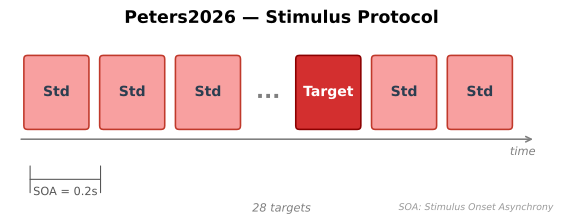
0.8s task window per trial · 2-class p300 / erp paradigm · 2 runs/session across 6 sessions
HED Event TagsHED tagsSource: MOABB BIDS HED annotation mapping.
TargetSensory-eventExperimental-stimulusVisual-presentationTargetNonTargetSensory-eventExperimental-stimulusVisual-presentationNon-targetHED tree view
Tree · Target
├─ Sensory-event ├─ Experimental-stimulus ├─ Visual-presentation └─ Target
Tree · NonTarget
├─ Sensory-event ├─ Experimental-stimulus ├─ Visual-presentation └─ Non-target
Channel SummaryTotal channels23EEG22 (dry)MISC1Montagestandard_1020Sampling300 HzReferencelinked ears ((A1 + A2) / 2), active common-mode followerFilter{'highpass': 0.003, 'lowpass': 150}Notch / line60 HzThis diagram is automatically generated from MOABB metadata. Please consult the original publication to confirm the experimental protocol details.
BCI-FIT longitudinal P300 calibration dataset from Peters et al. (2026).
BCI-FIT (BCI Functional Implementation Toolkit) is a customization protocol for non-implantable communication BCIs [1]. Five participants with speech and/or physical impairments due to amyotrophic lateral sclerosis (ALS;
sub-P1tosub-P5, demographics withheld by the authors) used the Matrix and RSVP typing layouts of BciPy 2.0 [2] over 6 to 10 visits each (9, 10, 9, 6 and 6). Between visits the system was customized (layout, timing, inquiry length, cap) from typing performance, participant preference, clinical observations and offline simulations.Task and events. Each calibration inquiry shows the target character (1 s), a cue (0.5 s) and then a stream of characters from a 28-symbol alphabet (A-Z,
<backspace,_space), flashed one at a time; the participant watches for the target. MOABB returns oneTargetorNonTargetepoch per flash, from thetargetandnontargetrows of the BIDSevents.tsv(each flash is also listed with its character, whichget_additional_metadata()returns ascharacter). Inquiry-preview and key-press rows are not epoched (the files have no prompt or cue rows). The README describes the default settings (55 inquiries of 14 flashes at 5 Hz, 10% of inquiries without a target, 4 s blank); the released runs follow the per-visit customization:stimulus onset asynchrony of 83 to 337 ms (about 12 Hz to 3 Hz), most runs at 237 ms (Matrix) or 203 ms (RSVP);
14 flashes per inquiry, or 28 in five Matrix runs of
sub-P2(visits 7 to 10), which have a target in every inquiry;eight runs with an inquiry preview confirmed by a switch press (
sub-P2visits 4 and 5 RSVP,sub-P4visits 3 to 5), most of them with 46 to 50 inquiries and few or no target-free inquiries.
The 88 calibration runs hold 4,472 inquiries and 66,150 flashes (4,109
Target, 62,041NonTarget). Seven runs end early and are kept as released: 1 inquiry (sub-P1visit 8 run 2,sub-P4visit 5 run 10,sub-P5visit 5 run 3), 2 or 5 inquiries (sub-P4visit 5 runs 4 and 1,sub-P3visit 2 RSVP run 6) and 33 inquiries (sub-P2visit 7 run 1).Sessions and runs. One MOABB session per visit,
"0"forses-1to"9"forses-10. Runs are named"<k>matrix"or"<k>rsvp", withkthe order of the calibration run within the visit (BIDS run order), so analyses can select or split by layout from the run name. 70 runs are Matrix and 18 RSVP; RSVP calibration only occurs in the early visits (sub-P11-3,sub-P21-6,sub-P31-4,sub-P41-2,sub-P51), later visits are Matrix-only.Caps and channels. Each visit used one dry-electrode cap (Wearable Sensing): the DSI-24 (19 scalp channels, 10-20 names with T3/T4/T5/T6, plus the A2 ear electrode, typed
mischere) or the DSI-Flex (7 channels).sub-P3,sub-P4andsub-P5used the DSI-24 throughout;sub-P1used the DSI-Flex at visit 1 and the DSI-24 afterwards;sub-P2used the DSI-Flex at visits 1 to 7 and the DSI-24 at visits 8 to 10. The two caps share only Cz, P3, Pz and P4. The DSI-Flex channels are Cz, Oz, P3, P4, PO7, PO8 and Pz, as named in the released files. The README lists FCz instead of Cz, but FCz is the DSI-Flex ground electrode (README and every DSI-Flex*_eeg.json), which cannot also be a recording site; BciPy’s own DSI-Flex device definition labels the cap’s first sensor Cz, and the BciPy BIDS conversion only keeps channels named in its 10-20 list, which has no FCz. This loader therefore keeps Cz and the standard Cz position. The ERPs and spectra of P1 and P2 could not tell Cz from FCz (ratios to Pz varied more between visits than between the two positions), so the evidence for Cz is documentary.MOABB evaluations load all subjects and visits into one array, so each variant of this loader returns a single channel set. By default (
cap=None) all 40 visits are returned with the four shared channels Cz, P3, Pz and P4.cap="DSI-24"returns the 32 DSI-24 visits (all five subjects;sub-P1visits 2-9,sub-P2visits 8-10) with the 19 DSI-24 channels (and A2 withreturn_all_modalities=True), andcap="DSI-Flex"the 8 DSI-Flex visits (sub-P1andsub-P2) with its 7 channels. Session keys always number the visit, socap="DSI-24"starts at session"1"forsub-P1. Positions come from the standard 10-20 template; the release’s electrode files hold template positions too, not digitized ones.Signal. Linked-ear reference ((A1 + A2) / 2) with an active common-mode follower; ground at FCz (DSI-Flex) or Fpz (DSI-24); hardware band 0.003-150 Hz. The released files are sampled at 300 Hz and are not filtered: the sidecars declare no software filter, and the recordings carry power above 20 Hz and, in most runs, 60 Hz line noise. The README’s downsampling to 150 Hz, 1-20 Hz band-pass and 60 Hz notch were therefore not applied to the distributed files; MOABB paradigms apply their own band-pass.
Timing and the late RSVP P300. Flash onsets are BciPy’s display-flip timestamps, shifted during the BIDS conversion by the static offset of the device (0.1 s), the same for both layouts; the release has no trigger or photodiode channel. In the 16 visits with both layouts, the Pz Target minus NonTarget wave peaks later in RSVP than in Matrix runs (cross-correlation delay 50 to 327 ms, median 92 ms; per participant the peak is at 380-450 ms in Matrix and 456-713 ms in RSVP runs), while the flash-locked steady-state visual response has the same latency in both layouts (median difference 7 ms, 95% CI -19 to 16 ms, in the 13 visits at 203 vs 237 ms SOA). A trigger offset would delay both, so the late RSVP P300 is a genuine latency difference and the events are not shifted. The [0, 0.8] s window still contains it.
Not included. The CopyPhrase runs (copy-spelling) are excluded: they are closed loop, with the classifier choosing the next inquiries and stopping at a 0.8 probability threshold, so they have no fixed Target/NonTarget design. The NEMAR mirror
on007720of the OpenNeuro release is used when available, with OpenNeuro as fallback; only the calibration files are downloaded (about 0.9 GB of the 2.3 GB release).Please cite the BCI-FIT poster [1] (the authors’ requested citation) and the OpenNeuro release [3]. Release 1.0.1 only changed text relative to 1.0.0; OpenNeuro has registered a DOI for 1.0.0 only.
- param subjects:
Subjects to load (1-5 for
sub-P1tosub-P5).- type subjects:
list of int | None
- param sessions:
Sessions (visits) to keep,
"0"beingses-1.- type sessions:
list of int | str | None
- param cap:
Nonereturns all visits with the channels both caps share (Cz, P3, Pz, P4); a cap name returns only that cap’s visits with its full channel set. Each variant has its owncode(Peters2026,Peters-dsi24-2026,Peters-dsiflex-2026), so caches and results stay apart; downloads are shared.- type cap:
None | “DSI-24” | “DSI-Flex”
- param return_all_modalities:
Also return non-EEG channels (A2 with
cap="DSI-24").- type return_all_modalities:
bool | dict
References
[1] (1,2)B. Peters, M. Kinsella, D. Klee, M. Lawhead, T. Memmott, S. Spaulding, B. Oken and M. Fried-Oken, “BCI-FIT: Effects of cBCI customization on performance,” poster, 11th International BCI Meeting, Banff, AB, Canada, June 2-5, 2025.
[2]T. Memmott, A. Koçanaoğulları, M. Lawhead, D. Klee, S. Dudy, M. Fried-Oken and B. Oken, “BciPy: brain-computer interface software in Python,” Brain-Computer Interfaces, vol. 8, no. 4, pp. 137-153, 2021. DOI: 10.1080/2326263X.2021.1878727
[3]B. Peters, D. Klee, M. Kinsella, Y. Hendin, T. Memmott, M. Lawhead, S. Ananthoju, B. Celik, S. Spaulding, B. Oken and M. Fried-Oken, “BCI-FIT: A customization protocol for communication brain-computer interface systems,” OpenNeuro ds007720, 2026. DOI: 10.18112/openneuro.ds007720.v1.0.0
from moabb.datasets import Peters2026

dataset = Peters2026()
data = dataset.get_data(subjects=[1])
print(data[1])
Dataset summary
#Subj
5
#Chan
4 (19 or 7 with cap)
#Trials / class
12408 NT / 822 T
Trials length
0.8 s
Freq
300 Hz
#Sessions
6-10
Participants
Population: patients
Clinical population: amyotrophic lateral sclerosis (ALS) with speech and/or physical impairments
BCI experience: mixed
Equipment
Amplifier: Wearable Sensing DSI-24 or DSI-Flex (dry electrodes)
Electrodes: dry
Montage: standard_1020
Reference: linked ears ((A1 + A2) / 2), active common-mode follower
Preprocessing
Data state: raw
Notes: Files are distributed unfiltered at the 300 Hz acquisition rate (60 Hz line noise in most runs); the README’s downsampling to 150 Hz, 1-20 Hz band-pass and 60 Hz notch are not applied to the distributed files.
Data Access
DOI: 10.18112/openneuro.ds007720.v1.0.0
Data URL: https://openneuro.org/datasets/ds007720
Repository: OpenNeuro
Experimental Protocol
Paradigm: p300
Task type: calibration
Tasks: MatrixCalibration, RSVPCalibration
Feedback: none
Stimulus: matrix or RSVP speller
Notes
Added in version 1.8.0.
- property all_subjects#
Full list of subjects available in this dataset (unfiltered).
- bids_paths(subject, path=None, force_update=False, update_path=None, verbose=None)[source]#
Calibration
.vhdrpaths of the selected visits, in visit/run order.
- convert_to_bids(path=None, subjects=None, overwrite=False, format='EDF', verbose=None, generate_figures=False)[source]#
Convert the dataset to BIDS format.
Saves the raw EEG data in a BIDS-compliant directory structure. Unlike the caching mechanism (see
CacheConfig), the files produced here do not contain a processing-pipeline hash (desc-<hash>) in their names, making the output a clean, shareable BIDS dataset.- Parameters:
path (str |
Path| None) – Directory under which the BIDS dataset will be written. IfNonethe default MNE data directory is used (same default as the rest of MOABB).subjects (list of int | None) – Subject numbers to convert. If
None, all subjects insubject_listare converted.overwrite (bool) – If
True, existing BIDS files for a subject are removed before saving. Default isFalse.format (str) – The file format for the raw EEG data. Supported values are
"EDF"(default),"BrainVision", and"EEGLAB".verbose (str | None) – Verbosity level forwarded to MNE/MNE-BIDS.
generate_figures (bool) – If
True, generate interactive neural signature HTML figures in{bids_root}/derivatives/neural_signatures/. Requiresplotly(pip install moabb[interactive]). Default isFalse.
- Returns:
bids_root – Path to the root of the written BIDS dataset.
- Return type:
Examples
>>> from moabb.datasets import AlexMI
>>> dataset = AlexMI()
>>> bids_root = dataset.convert_to_bids(path="/tmp/bids", subjects=[1])
Notes
Use
CacheConfigto configure caching forget_data(). Usemoabb.datasets.bids_interface.get_bids_rootto get the BIDS root path.Added in version 1.5.
- data_path(subject, path=None, force_update=False, update_path=None, verbose=None)[source]#
Get path to local copy of a subject data.
- Parameters:
subject (int) – Number of subject to use
path (None | str) – Location of where to look for the data storing location. If None, the environment variable or config parameter
MNE_DATASETS_(dataset)_PATHis used. If it doesn’t exist, the “~/mne_data” directory is used. If the dataset is not found under the given path, the data will be automatically downloaded to the specified folder.force_update (bool) – Force update of the dataset even if a local copy exists.
update_path (bool | None Deprecated) – If True, set the MNE_DATASETS_(dataset)_PATH in mne-python config to the given path. If None, the user is prompted.
verbose (bool, str, int, or None) – If not None, override default verbose level (see
mne.verbose()).
- Returns:
path – Local path to the given data file. This path is contained inside a list of length one, for compatibility.
- Return type:
- download(subject_list=None, path=None, force_update=False, update_path=None, accept=False, verbose=None)[source]#
Download the calibration files of the given subjects.
- get_additional_metadata(subject, session, run)[source]#
Per-flash metadata: label, presented character, layout, BIDS run, cap.
- get_block_repetition(paradigm, subjects, block_list, repetition_list)[source]#
Select data for all provided subjects, blocks and repetitions.
subject -> session -> run -> block -> repetition
See also
- get_data(subjects=None, cache_config=None, process_pipeline=None, n_jobs=1)[source]#
Return the data corresponding to a list of subjects.
The returned data is a dictionary with the following structure:
data = {"subject_id": {"session_id": {"run_id": run}}}
subjects are on top, then we have sessions, then runs. A sessions is a recording done in a single day, without removing the EEG cap. A session is constitued of at least one run. A run is a single contiguous recording. Some dataset break session in multiple runs.
Processing steps can optionally be applied to the data using the
*_pipelinearguments. These pipelines are applied in the following order:raw_pipeline->epochs_pipeline->array_pipeline. If a*_pipelineargument isNone, the step will be skipped. Therefore, thearray_pipelinemay either receive amne.io.Rawor amne.Epochsobject as input depending on whetherepochs_pipelineisNoneor not.- Parameters:
subjects (List of int) – List of subject number
cache_config (dict |
CacheConfig) – Configuration for caching of datasets. SeeCacheConfigfor details.process_pipeline (
sklearn.pipeline.Pipeline| None) – Optional processing pipeline to apply to the data. To generate an adequate pipeline, we recommend usingmoabb.make_process_pipelines(). This pipeline will receivemne.io.BaseRawobjects. The steps names of this pipeline should be elements ofStepType. According to their name, the steps should either return amne.io.BaseRaw, amne.Epochs, or anumpy.ndarray. This pipeline must be “fixed” because it will not be trained, i.e. no call tofitwill be made.n_jobs (int) – Number of jobs to run in parallel over subjects (passed to
joblib.Parallel). Default1(sequential). Per-subject processing (reading, filtering, resampling, epoching) is independent, so this gives a near-linear speedup for datasets with many subjects.
- Returns:
data – dict containing the raw data
- Return type:
Dict
- property metadata[source]#
Return structured metadata for this dataset.
Returns the DatasetMetadata object from the centralized catalog, or None if metadata is not available for this dataset.
- Returns:
The metadata object containing acquisition parameters, participant demographics, experiment details, and documentation. Returns None if no metadata is registered for this dataset.
- Return type:
DatasetMetadata| None
Examples
>>> from moabb.datasets import BNCI2014_001
>>> dataset = BNCI2014_001()
>>> dataset.metadata.participants.n_subjects
9
>>> dataset.metadata.acquisition.sampling_rate
250.0
- sourcedata_path(subject=None, path=None, force_update=False, verbose=None)[source]#
Get the dataset’s original pre-BIDS distribution from NEMAR.
Where
data_path()fetches the original files from the upstream host, this fetches the copy NEMAR mirrors undersourcedata/. The files keep their upstream names, so the two are interchangeable in content – but NEMAR stays reachable when the upstream host is slow, rate-limited, behind a bot gate, or retired.- Parameters:
subject (int | str | None) – Restrict the download to one subject, resolved through the deposit’s
sourcedata_provenance.json. Deposits enriched before that manifest recorded subjects fall back to the whole tree with a warning. WhenNonethe whole tree is fetched.path (None | str) – Base path where MOABB stores datasets.
force_update (bool) – Re-fetch even when a local copy is present.
verbose (bool, str, int, or None) – If not None, override default verbose level.
- Returns:
Local path to the
sourcedatadirectory.- Return type:
- Raises:
ValueError – If the dataset declares no
nemar_id.moabb.datasets.download.NemarDownloadError – If the download fails or the deposit publishes no
sourcedata/.
- upstream_source = 'OpenNeuro'#
Name of the upstream host, used in the fallback warning.