

moabb.datasets.BI2012#
- class moabb.datasets.BI2012(training=True, online=False, subjects=None, sessions=None, *, return_all_modalities=False, **kwargs)[source]#
Bases:
BaseDataset[source]Dataset Snapshot
BI2012
EEG recordings of 25 subjects testing the Brain Invaders, a visual P300 Brain-Computer Interface inspired by the famous vintage video game Space Invaders
P300 / ERP, 2 classes (Target vs NonTarget)
P300 / ERP Code: BrainInvaders2012 25 subjects 1 session 16 ch 128 Hz 2 classes 1.0 s trials CC BY 4.0Class Labels: Target, NonTarget
Benchmark Context
WithinSessionIncluded in 1 MOABB benchmark table(s). Scores are across available pipelines (WithinSession accuracy).
- ERP/P300 all classes 5 pipelinesMax 90.99 · Median 79.02 · Mean 80.28 · Std 10.41
Citation & Impact
- Paper DOI10.5281/zenodo.2649006
- CitationsLoading…
- Public APICrossref | OpenAlex
- MOABB tables1 (WithinSession)
- Page Views30d: 0 · all-time: 442#24 of 152 · Top 16% most viewedUpdated: 2026-10-16 UTC
Stimulus Protocol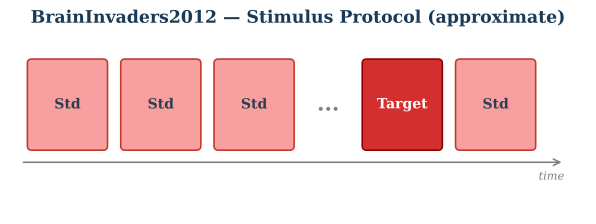
1s task window per trial · 2-class p300 / erp paradigm · 2 runs/session across 1 sessions
HED Event TagsHED tagsSource: MOABB BIDS HED annotation mapping.
TargetSensory-eventExperimental-stimulusVisual-presentationTargetNonTargetSensory-eventExperimental-stimulusVisual-presentationNon-targetHED tree view
Tree · Target
├─ Sensory-event ├─ Experimental-stimulus ├─ Visual-presentation └─ Target
Tree · NonTarget
├─ Sensory-event ├─ Experimental-stimulus ├─ Visual-presentation └─ Non-target
Channel SummaryTotal channels16EEG16 (EEG)Montagestandard_1020Sampling128 HzReferencehardware common average referenceNotch / line50 HzThis diagram is automatically generated from MOABB metadata. Please consult the original publication to confirm the experimental protocol details.
P300 dataset BI2012 from a “Brain Invaders” experiment.
Dataset following the setup from [1] carried-out at University of Grenoble Alpes.
This dataset contains electroencephalographic (EEG) recordings of 25 subjects testing the Brain Invaders, a visual P300 Brain-Computer Interface inspired by the famous vintage video game Space Invaders (Taito, Tokyo, Japan). The visual P300 is an event-related potential elicited by a visual stimulation, peaking 240-600 ms after stimulus onset. EEG data were recorded by 16 electrodes in an experiment that took place in the GIPSA-lab, Grenoble, France, in 2012). A full description of the experiment is available in [1].
- Principal Investigator:
B.Sc. Gijsbrecht Franciscus Petrus Van Veen
- Technical Supervisors:
Ph.D. Alexandre Barachant, Eng. Anton Andreev, Eng. Grégoire Cattan, Eng. Pedro. L. C. Rodrigues
- Scientific Supervisor:
Ph.D. Marco Congedo
- ID of the dataset:
BI.EEG.2012-GIPSA
References
from moabb.datasets import BI2012

dataset = BI2012()
data = dataset.get_data(subjects=[1])
print(data[1])
Dataset summary
#Subj
25
#Chan
16
#Trials / class
640 NT / 128 T
Trials length
1 s
Freq
128 Hz
#Sessions
1
Participants
Population: healthy
Age: 24.4 (range: 21-31) years
BCI experience: half played games occasionally (around 4.5 hours a week)
Equipment
Amplifier: NeXus-32 (MindMedia/TMSi)
Electrodes: EEG
Montage: standard_1020
Reference: hardware common average reference
Preprocessing
Data state: raw EEG with software tagging (note: tagging introduces jitter and latency)
Notes: Software tagging introduces a jitter and a latency which artificially modify the ERPs onset. Strong drift over time resulting in higher jitter. Only possible to compare ERP acquired within the same experimental conditions when latency is not corrected.
Data Access
DOI: 10.5281/zenodo.2649006
Data URL: https://doi.org/10.5281/zenodo.2649006
Repository: Zenodo
Experimental Protocol
Paradigm: p300
Feedback: visual (game interface)
Stimulus: visual flashes of alien groups
Notes
Added in version 0.4.6.
- __init__(training=True, online=False, subjects=None, sessions=None, *, return_all_modalities=False, **kwargs)[source]#
Initialize function for the BaseDataset.
- property all_subjects#
Full list of subjects available in this dataset (unfiltered).
- convert_to_bids(path=None, subjects=None, overwrite=False, format='EDF', verbose=None, generate_figures=False)[source]#
Convert the dataset to BIDS format.
Saves the raw EEG data in a BIDS-compliant directory structure. Unlike the caching mechanism (see
CacheConfig), the files produced here do not contain a processing-pipeline hash (desc-<hash>) in their names, making the output a clean, shareable BIDS dataset.- Parameters:
path (str |
Path| None) – Directory under which the BIDS dataset will be written. IfNonethe default MNE data directory is used (same default as the rest of MOABB).subjects (list of int | None) – Subject numbers to convert. If
None, all subjects insubject_listare converted.overwrite (bool) – If
True, existing BIDS files for a subject are removed before saving. Default isFalse.format (str) – The file format for the raw EEG data. Supported values are
"EDF"(default),"BrainVision", and"EEGLAB".verbose (str | None) – Verbosity level forwarded to MNE/MNE-BIDS.
generate_figures (bool) – If
True, generate interactive neural signature HTML figures in{bids_root}/derivatives/neural_signatures/. Requiresplotly(pip install moabb[interactive]). Default isFalse.
- Returns:
bids_root – Path to the root of the written BIDS dataset.
- Return type:
Examples
>>> from moabb.datasets import AlexMI
>>> dataset = AlexMI()
>>> bids_root = dataset.convert_to_bids(path="/tmp/bids", subjects=[1])
Notes
Use
CacheConfigto configure caching forget_data(). Usemoabb.datasets.bids_interface.get_bids_rootto get the BIDS root path.Added in version 1.5.
- data_path(subject, path=None, force_update=False, update_path=None, verbose=None)[source]#
Get path to local copy of a subject data.
- Parameters:
subject (int) – Number of subject to use
path (None | str) – Location of where to look for the data storing location. If None, the environment variable or config parameter
MNE_DATASETS_(dataset)_PATHis used. If it doesn’t exist, the “~/mne_data” directory is used. If the dataset is not found under the given path, the data will be automatically downloaded to the specified folder.force_update (bool) – Force update of the dataset even if a local copy exists.
update_path (bool | None Deprecated) – If True, set the MNE_DATASETS_(dataset)_PATH in mne-python config to the given path. If None, the user is prompted.
verbose (bool, str, int, or None) – If not None, override default verbose level (see
mne.verbose()).
- Returns:
path – Local path to the given data file. This path is contained inside a list of length one, for compatibility.
- Return type:
- download(subject_list=None, path=None, force_update=False, update_path=None, accept=False, verbose=None)[source]#
Download all data from the dataset.
This function is only useful to download all the dataset at once.
When the dataset declares a
nemar_idand the download provider is not"upstream", the files come from NEMAR’ssourcedata/– the original pre-BIDS distribution, byte-identical to what the upstream host serves. On any NEMAR failure this falls back to the dataset’s own downloader with a warning (unless the provider is pinned to"nemar"). Seesourcedata_path()andmoabb.set_download_provider().- Parameters:
subject_list (list of int | None) – List of subjects id to download, if None all subjects are downloaded. On the NEMAR path each subject is resolved through the deposit’s
sourcedata_provenance.json; deposits enriched before that manifest recorded subjects fetch the whole tree.path (None | str) – Location of where to look for the data storing location. If None, the environment variable or config parameter
MNE_DATASETS_(dataset)_PATHis used. If it doesn’t exist, the “~/mne_data” directory is used. If the dataset is not found under the given path, the data will be automatically downloaded to the specified folder.force_update (bool) – Force update of the dataset even if a local copy exists.
update_path (bool | None) – If True, set the MNE_DATASETS_(dataset)_PATH in mne-python config to the given path. If None, the user is prompted. Not used on the NEMAR path.
accept (bool) – Accept licence term to download the data, if any. Default: False. Only relevant to the dataset’s own downloader; NEMAR mirrors are already public.
verbose (bool, str, int, or None) – If not None, override default verbose level (see
mne.verbose()).
- get_additional_metadata(subject: str, session: str, run: str)[source]#
Load additional metadata for a specific subject, session, and run.
This method is intended to be overridden by subclasses to provide additional metadata specific to the dataset. The metadata is typically loaded from an events.tsv file or similar data source.
- Parameters:
- Returns:
A DataFrame containing the additional metadata if available, otherwise None.
- Return type:
None |
pandas.DataFrame
- get_block_repetition(paradigm, subjects, block_list, repetition_list)[source]#
Select data for all provided subjects, blocks and repetitions.
subject -> session -> run -> block -> repetition
See also
- get_data(subjects=None, cache_config=None, process_pipeline=None, n_jobs=1)[source]#
Return the data corresponding to a list of subjects.
The returned data is a dictionary with the following structure:
data = {"subject_id": {"session_id": {"run_id": run}}}
subjects are on top, then we have sessions, then runs. A sessions is a recording done in a single day, without removing the EEG cap. A session is constitued of at least one run. A run is a single contiguous recording. Some dataset break session in multiple runs.
Processing steps can optionally be applied to the data using the
*_pipelinearguments. These pipelines are applied in the following order:raw_pipeline->epochs_pipeline->array_pipeline. If a*_pipelineargument isNone, the step will be skipped. Therefore, thearray_pipelinemay either receive amne.io.Rawor amne.Epochsobject as input depending on whetherepochs_pipelineisNoneor not.- Parameters:
subjects (List of int) – List of subject number
cache_config (dict |
CacheConfig) – Configuration for caching of datasets. SeeCacheConfigfor details.process_pipeline (
sklearn.pipeline.Pipeline| None) – Optional processing pipeline to apply to the data. To generate an adequate pipeline, we recommend usingmoabb.make_process_pipelines(). This pipeline will receivemne.io.BaseRawobjects. The steps names of this pipeline should be elements ofStepType. According to their name, the steps should either return amne.io.BaseRaw, amne.Epochs, or anumpy.ndarray. This pipeline must be “fixed” because it will not be trained, i.e. no call tofitwill be made.n_jobs (int) – Number of jobs to run in parallel over subjects (passed to
joblib.Parallel). Default1(sequential). Per-subject processing (reading, filtering, resampling, epoching) is independent, so this gives a near-linear speedup for datasets with many subjects.
- Returns:
data – dict containing the raw data
- Return type:
Dict
- property metadata[source]#
Return structured metadata for this dataset.
Returns the DatasetMetadata object from the centralized catalog, or None if metadata is not available for this dataset.
- Returns:
The metadata object containing acquisition parameters, participant demographics, experiment details, and documentation. Returns None if no metadata is registered for this dataset.
- Return type:
DatasetMetadata| None
Examples
>>> from moabb.datasets import BNCI2014_001
>>> dataset = BNCI2014_001()
>>> dataset.metadata.participants.n_subjects
9
>>> dataset.metadata.acquisition.sampling_rate
250.0
- sourcedata_path(subject=None, path=None, force_update=False, verbose=None)[source]#
Get the dataset’s original pre-BIDS distribution from NEMAR.
Where
data_path()fetches the original files from the upstream host, this fetches the copy NEMAR mirrors undersourcedata/. The files keep their upstream names, so the two are interchangeable in content – but NEMAR stays reachable when the upstream host is slow, rate-limited, behind a bot gate, or retired.- Parameters:
subject (int | str | None) – Restrict the download to one subject, resolved through the deposit’s
sourcedata_provenance.json. Deposits enriched before that manifest recorded subjects fall back to the whole tree with a warning. WhenNonethe whole tree is fetched.path (None | str) – Base path where MOABB stores datasets.
force_update (bool) – Re-fetch even when a local copy is present.
verbose (bool, str, int, or None) – If not None, override default verbose level.
- Returns:
Local path to the
sourcedatadirectory.- Return type:
- Raises:
ValueError – If the dataset declares no
nemar_id.moabb.datasets.download.NemarDownloadError – If the download fails or the deposit publishes no
sourcedata/.