

moabb.evaluations.CrossSubjectEvaluation#
- class moabb.evaluations.CrossSubjectEvaluation(*args, cs_mode=CrossSubjectMode.TRAIN, splitter: BaseCrossValidator | None = None, **kwargs)[source]#
Cross-subject evaluation performance.
Evaluate performance of the pipeline trained on all subjects but one, concatenating sessions.
- Parameters:
paradigm (
BaseParadigm) – The paradigm to use.datasets (list of
BaseDataset) – The list of dataset to run the evaluation. If none, the list of compatible dataset will be retrieved from the paradigm instance.random_state (int or None) – If not None, can guarantee same seed for shuffling examples. Defaults to
None.n_jobs (int) – Number of jobs for fitting of pipeline. Defaults to
1.overwrite (bool) – If true, overwrite the results. Defaults to
False.error_score (str or float) – Value to assign to the score if an error occurs in estimator fitting. If set to
'raise', the error is raised. Defaults to"raise".suffix (str) – Suffix for the results file.
hdf5_path (str) – Specific path for storing the results and models.
additional_columns (None) – Adding information to results.
return_epochs (bool) – Use MNE epoch to train pipelines. Defaults to
False.return_raws (bool) – Use MNE raw to train pipelines. Defaults to
False.mne_labels (bool) – If returning MNE epoch, use original dataset label if True. Defaults to
False.save_model (bool) – Save model after training, for each fold of cross-validation if needed. Defaults to
False.cache_config (
CacheConfigor None) – Configuration for caching of datasets. Seemoabb.datasets.base.CacheConfigfor details. Defaults toNone.n_splits (int or None) – Number of splits for cross-validation. If None, the number of splits is equal to the number of subjects. Defaults to
None.cv_class (type or None) – Cross-validation strategy used to hold out subjects (e.g.
LeaveOneGroupOut,GroupShuffleSplit,GroupKFold). Defaults toNone(LeaveOneGroupOut, orGroupKFoldwhenn_splitsis set). A metadata-aware splitter class (one that declaresmetadata_columnsand implementssplit(self, y, metadata)) is instead built withcv_kwargsand used directly, likesplitter; it may leave rows out of both train and test.cv_kwargs (dict) – Keyword arguments for
cv_class.calibration_size(float in[0, 1], default0.0) enables transfer learning: when> 0each fold becomes(train, calibration, test). The fraction is taken within every held-out subject/session pair so each remains scorable, and the calibration slice is routed (raw) to pipeline steps viaset_fit_request. Withcalibration_labeled=False, onlyX_target_unlabeledmay be routed. Withcalibration_labeled=True,X_target_labeledandy_target_labeledmay be routed. Labeled calibration is only allowed withcalibration_size <= 0.5.cs_mode (CrossSubjectMode or str, default=CrossSubjectMode.TRAIN) – Named cross-subject protocol preset. By default, this is the standard train-only cross-subject evaluation with no target calibration. The
TRAIN_TRIALWISEmode additionally enforces one-trial-at-a-time prediction during scoring and supports the built-in"accuracy"and"roc_auc"metrics. Cannot be combined with manualcalibration_sizeorcalibration_labeledincv_kwargs, except for the defaultTRAINmode.splitter (BaseCrossValidator or None) – Optional top-level cross-subject splitter. It must follow MOABB’s
split(y, metadata)contract and yield unique, in-range, one-dimensional positional integer indices intoyandmetadatafor either train/test or train/calibration/test slices. The slices must be pairwise disjoint. Each test fold must contain exactly one subject, matching MOABB’s per-subject result-row semantics. When provided, it replacesCrossSubjectSplitterand cannot be combined withcv_class,cv_kwargs,n_splits,groups, or a non-defaultcs_mode. Defaults toNone.
Notes
Added in version 1.1.0: Add save_model, cache_config and n_splits parameters
- evaluate(dataset: BaseDataset, pipelines: dict, param_grid: dict | None, process_pipeline, postprocess_pipeline=None)[source]#
Evaluate results on a single dataset.
This method return a generator. each results item is a dict with the following conversion:
res = {'time': Duration of the training ,
       'dataset': dataset id,
       'subject': subject id,
       'session': session id,
       'score': score,
       'n_samples': number of training examples,
       'n_channels': number of channel,
       'pipeline': pipeline name}
- is_valid(dataset: BaseDataset) bool[source]#
Verify the dataset is compatible with evaluation.
This method is called to verify dataset given in the constructor are compatible with the evaluation context.
This method should return false if the dataset does not match the evaluation. This is for example the case if the dataset does not contain enough session for a cross-session eval.
- Parameters:
dataset (
BaseDataset) – The dataset to verify.
Examples using moabb.evaluations.CrossSubjectEvaluation#
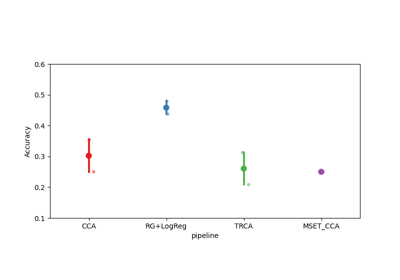
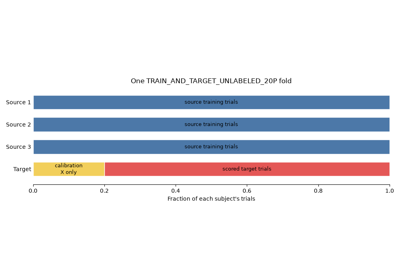
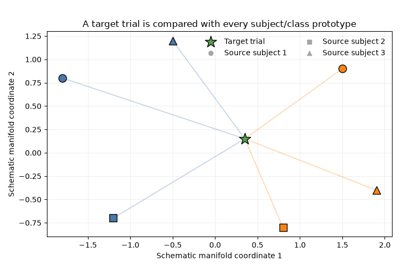
Trialwise cross-subject subject-prototype classification