

Note
Go to the end to download the full example code.
Cross-Session on Multiple Datasets#
This example shows how to perform a cross-session analysis on two MI datasets using a CSP+LDA pipeline
The cross session evaluation context will evaluate performance using a leave one session out cross-validation. For each session in the dataset, a model is trained on every other session and performance are evaluated on the current session.
# Authors: Sylvain Chevallier <sylvain.chevallier@uvsq.fr>
#
# License: BSD (3-clause)

import warnings

import matplotlib.pyplot as plt
import seaborn as sns
from mne.decoding import CSP
from sklearn.discriminant_analysis import LinearDiscriminantAnalysis as LDA
from sklearn.pipeline import make_pipeline

import moabb
from moabb.datasets import BNCI2014_001, Zhou2016
from moabb.evaluations import CrossSessionEvaluation
from moabb.paradigms import LeftRightImagery


warnings.simplefilter(action="ignore", category=FutureWarning)
warnings.simplefilter(action="ignore", category=RuntimeWarning)
moabb.set_log_level("info")
Loading Dataset#
Load 2 subjects of BNCI 2014-004 and Zhou2016 datasets, with 2 session each
subjects_list = [1, 2]

datasets = [Zhou2016(), BNCI2014_001()]

for d in datasets:
    # replace the subject list
    d.subject_list = subjects_list
Choose Paradigm#
We select the paradigm MI, applying a bandpass filter (8-35 Hz) on the data and we will keep only left- and right-hand motor imagery
paradigm = LeftRightImagery(fmin=8, fmax=35)
Create Pipelines#
Use the Common Spatial Patterns with 8 components and a Linear Discriminant Analysis classifier.
pipeline = {}
pipeline["CSP+LDA"] = make_pipeline(CSP(n_components=8), LDA())
Get Data (optional)#
To get access to the EEG signals downloaded from the dataset, you could use dataset.get_data(subjects=[subject_id]) to obtain the EEG under an MNE format, stored in a dictionary of sessions and runs. Otherwise, paradigm.get_data(dataset=dataset, subjects=[subject_id]) allows to obtain the EEG data in sklearn format, the labels and the meta information. The data are preprocessed according to the paradigm requirements.
# X_all, labels_all, meta_all = [], [], []
# for d in datasets:
#     # sessions = d.get_data(subjects=[2])
#     X, labels, meta = paradigm.get_data(dataset=d, subjects=[2])
#     X_all.append(X)
#     labels_all.append(labels)
#     meta_all.append(meta)
Evaluation#
The evaluation will return a DataFrame containing a single AUC score for each subject / session of the dataset, and for each pipeline.
overwrite = True  # set to True if we want to overwrite cached results

evaluation = CrossSessionEvaluation(
    paradigm=paradigm, datasets=datasets, suffix="examples", overwrite=overwrite
)
results = evaluation.process(pipeline)

print(results.head())
This is nemar-py 0.3.3.
Preparing to download nm000115 from https://data.nemar.org/
This is nemar-py 0.3.3.
Preparing to download nm000115 from https://data.nemar.org/
This is nemar-py 0.3.3.
Preparing to download nm000115 from https://data.nemar.org/
This is nemar-py 0.3.3.
Preparing to download nm000115 from https://data.nemar.org/
     score      time  ...  pipeline                  codecarbon_task_name
0  0.85113  0.186245  ...   CSP+LDA  cd3be1a2-284c-4f4d-9cbb-4b41ecba08c1
1  0.93640  0.138367  ...   CSP+LDA  ff1a856b-50c6-4faf-ace4-715d7734134e
2  0.93960  0.172045  ...   CSP+LDA  9203ed77-a538-4bcf-bd34-a4f0e6a2b64c
3  0.90800  0.153884  ...   CSP+LDA  485ad62b-6b1b-4912-8535-5bb62f5f2f7e
4  0.77037  0.167581  ...   CSP+LDA  015b8831-e787-414c-9d52-605600e7f380

[5 rows x 13 columns]
Plot Results#
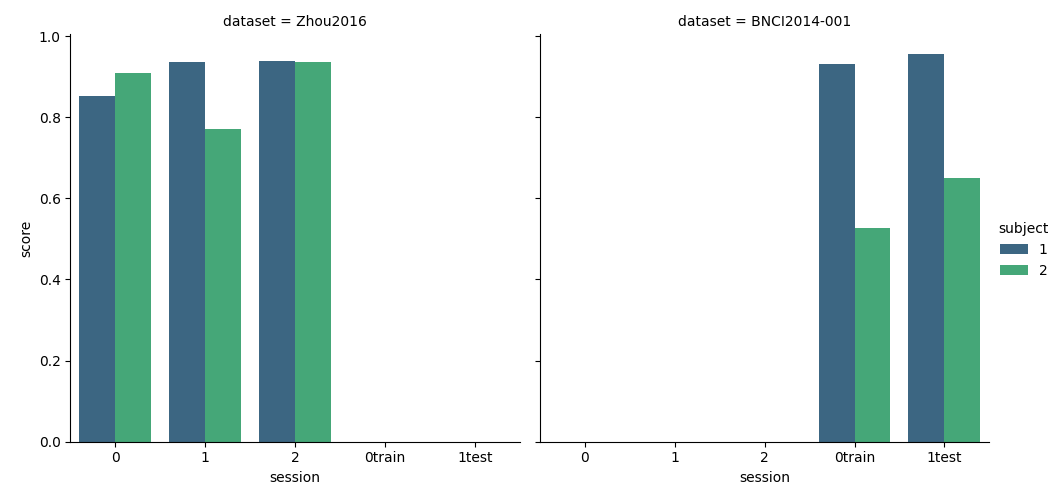
Here we plot the results, indicating the score for each session and subject
Total running time of the script: (0 minutes 13.829 seconds)
Run this example
